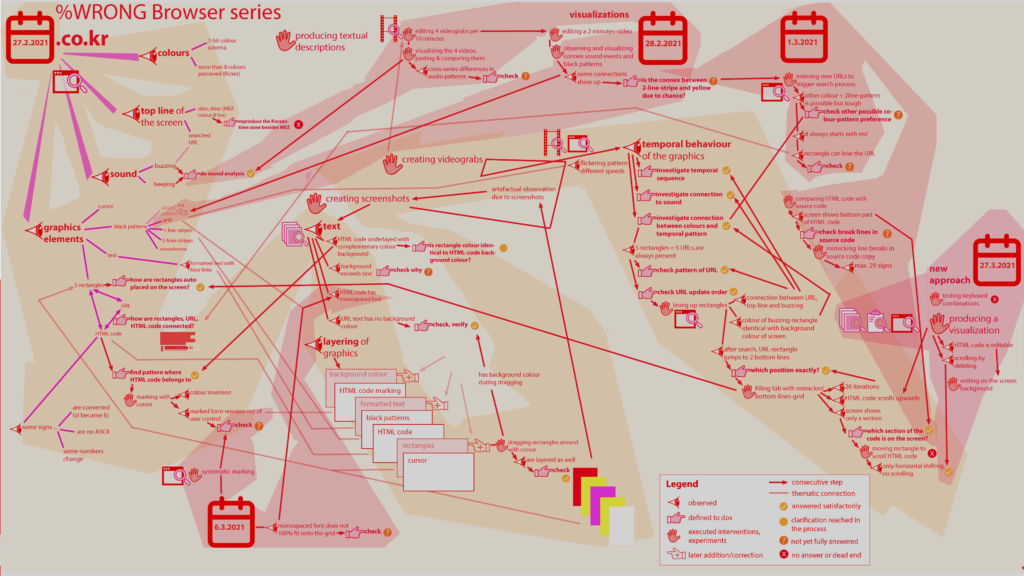
“Online pieces have ‘roots’ that extend much deeper.”
Let’s go down the rabbit hole …
Coded Secrets (COSE) is an ERC Consolidator research group led by Inge Hinterwaldner. We seek new methods for analysing software-based artworks, with a special focus on net art from the 1990s to the present.
Conceiving the artwork as the perceived and the performed, the surface and the coded, the phenomenal and the infrastructural
What lies beneath the surface of computational artworks? Online pieces have “roots” that extend far deeper than the flat screens on which we view them — they may even be distributed, occupying multiple sites across the Internet at once. No one has ever been able to see the responsive, connective agency of these works with their own eyes. COSE sets out to reveal the inner workings of code-based artworks, along with their embeddedness in the many niches of the World Wide Web. Shedding light on this black box allows us to gain a fuller appreciation of these artworks and equips scholars in the humanities to confront programmed works — offering both analytical instruments and a broader understanding of our media-technological condition.
Archaeological and forensic dimensions in retrieving and understanding artworks
The artistic works under analysis are all hidden, concealed, or otherwise withdrawn — a condition of the networked situations into which they were inserted. Because art historians tend to favour surface features, such works are often overlooked, or crucial aspects of their design — code, files, software performance — go unexamined. Precisely because these interventions operate in non-standard locations, they point to the very moments where artists saw an opportunity to critically exploit the specifics of the net in order to deliver a message. COSE offers a new view of the Internet through the lens of these artworks, which reclaim the right to diversify Internet access and use in productive ways. To recover these long-neglected aspects, an interdisciplinary team complements art-historical methods with approaches from media studies, game studies, code studies, software forensics, and visual design.
Tool design and the Software Art Lab
Not everyone in art history is a “techie.” We explore how to scale up our analytical capacities by developing software tools and building an environment in which these tools can be assembled, connected, and sustained over time.
Model building in art history and alternative forms of publication
Taking the artworks as our starting point, we present the Internet as a complex of activated affordances rather than yet another node-graph diagram. COSE develops an original pictorial language to generate immersive views into the specific “machine rooms” of these artworks and their ecosystems — rendered as a processual, deep topology. We also experiment with how best to convey complex data in academic yet exploratory ways. Among our outcomes so far are physical and digital models, as well as a triple publication: one and the same study rendered across three modalities — a book, a game (a walk-through version of the book), and a game guide.
Funding Acknowledgements
This study receives generous funding from the European Research Council (ERC) under the European Union’s Horizon 2020 research and innovation programme under grant agreement COSE, No. 101045376.

2022-2026 the project was hosted at Karlsruhe Institute of Technology, Germany.

2026-2028 the project is hosted at the Free University of Bozen-Bolzano, Italy.