
Prof. Dr. Inge Hinterwaldner
Faculty of Design and Art
Free University of Bozen-Bolzano
Piazza Università 1
I-39100 Bolzano
inge.hinterwaldner(@) unibz.it
Prof. Dr. Inge Hinterwaldner studied art history, archaeology and history at the University of Innsbruck from 1995 to 2000. She received her doctorate in art history with a study on interactive computer simulations from the University of Basel in 2009. In the context of the National Centre of Competence in Research “Image Criticism” she headed the interdisciplinary research group “Image and Model” (2009-2013) together with sociologist Martina Merz and computer scientist Thomas Vetter. She has also taught at the Universities of Berne, Lucerne and the HGK Basel. In 2013 she taught as deputy professor at the Institute for Philosophy and Art Studies at Leuphana University Lüneburg. Research residencies took her to Lüneburg in 2014 for the DFG research group “Media Cultures of Computer Simulation” (MECS), to Duke University in Durham in 2014-2105 and to MIT in Cambridge in 2015-2016. In October 2016 she became Professor of Art and Visual History of Modern and Contemporary Art at Humboldt-University Berlin. 2018-2026 she taught history of art and design at KIT. 2019-2023 she was PI of the DFG-funded research group “Browser Art”. Since 2022 she is PI of the ERC CoG “Coded Secrets” (COSE). In February 2026 she joined the faculty at the Faculty of Design and Art at the Free University of Bozen-Bolzano.
Her research interests include image theory, model theory, theory of interactivity and temporality in the arts, machine- and computer-based art and architecture, digital art in its ecosystem, the interdependence of arts and sciences since the 19th century, and the development of analytic methods and publishing formats.
Full version of the CV.
Vita
Awards
- 2020: Fakultätslehrpreis für Exzellente Lehre, von der KIT-Fakultät für Architektur
- 2014: The Schachterle Essay Prize für den Aufsatz “Parallel lines as tools for making turbulence visible” (2013). Jährlicher Preis, vergeben durch die Society for Literature, Science and the Arts, für den besten Aufsatz zu Literatur und Wissenschaft in englischer Sprache durch eine*n nontenured Wissenschaftler*in
- 2013: Preis “Geisteswissenschaften International”, eine besondere Anerkennung innerhalb der Auszeichnung Geisteswissenschaften International zur Förderung exzellenter geistes- und sozialwissenschaftlicher Publikationen, für die englische Übersetzung der Dissertation (verliehen vom Börsenverein des Deutschen Buchhandels e.V., Fritz Thyssen Stiftung, VG Wort und vom deutschen Auswärtigen Amt)
- 2010: Preis für Geisteswissenschaften, verliehen von der Philosophisch-Historischen Fakultät, Universität Basel als Auszeichnung für die beste Dissertation des akademischen Jahres 2009/2010 (gestiftet von der Genossenschaft Migros Basel)
Third-party funded research groups
- 2022-2028: Coded Secrets: Artistic Interventions Hidden in the Digital Fabric (COSE), ERC Consolidator Grant, EU (PI)
- 2019-2022: Browserkunst. Navigieren mit Stil/Browser Art. Navigating with Style, DFG/German Science foundation, DE (PI)
- 2009-2013: Bild und Modell/Image and Model, SNF/Swiss National Science Foundation, CH (Co-PI)
Grants
- 2014-2016: Advanced Postdoc-Mobility Stipendium des SNF für je ein Jahr Forschungsaufenthalt an der Duke University, Durham [USA]; am Massachusetts Institute of Technology, Cambridge [USA]
- 2014: Research Fellowship der Kolleg-Forschergruppe “Medienkulturen der Computersimulation” (MECS), Leuphana Universität Lüneburg [D]
- 2011: Fellowship des Stone Summer Theory Institute “Farewell to Visual Studies”, Chicago [USA]
- 2006-2008: Promotionsstipendium: Graduiertenkolleg “Bild und Wissen”, Schweizerischer Nationalfonds [CH]
- 2003-2006: Promotionsstipendium: Graduiertenkolleg “Bild. Körper. Medium. Eine anthropologische Perspektive”, DFG [D]
- 1999: Stipendium für die Erstellung der Diplomarbeit: Emanuel und Sophie Fohn-Stipendienstiftung Wien für höchstbegabte Studierende und Studienabsolventen, Wien [A]
Publications
The publications can be downloaded here or on the following platforms:
Academia.edu: https://kit.academia.edu/IngeHinterwaldner
Research.net: https://www.researchgate.net/profile/Inge_Hinterwaldner
Authored books
Edited volumes



Research
My research likes to break new ground in the field of computer-based contemporary art in all its facets. I am curious and open to explore interdisciplinary borders or transgressions (into chemistry, physics, ecology, medicine, psychology, advertising, conservation and computer science), since fascinating and complex image phenomena can be found there as well.

Coded Secrets The research project investigates born-digital artworks that ‘live’ online. They occupy interesting sites in the complex ecosystem online and we want to find what agency and meaning these works develop because they are situated (in contrast to free floating through sharing).

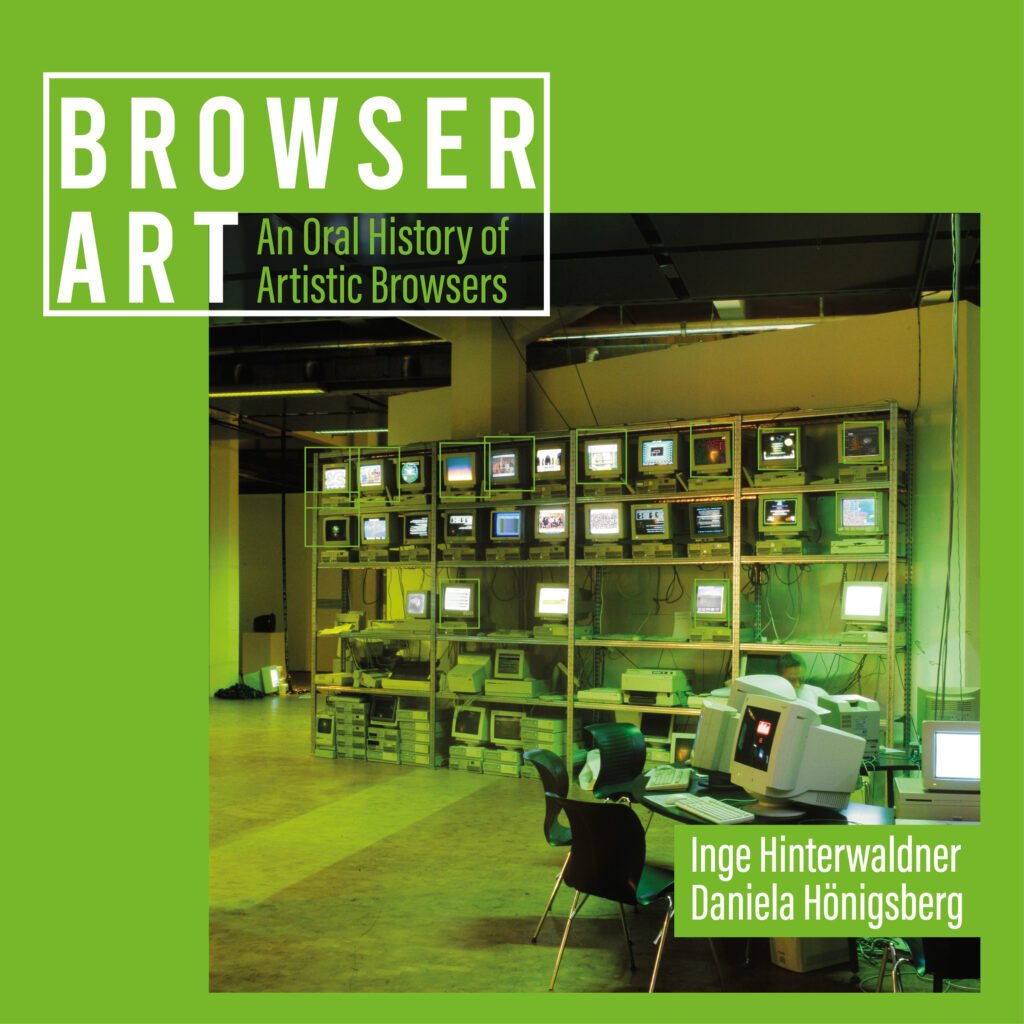
Browser Art. Navigate With Style
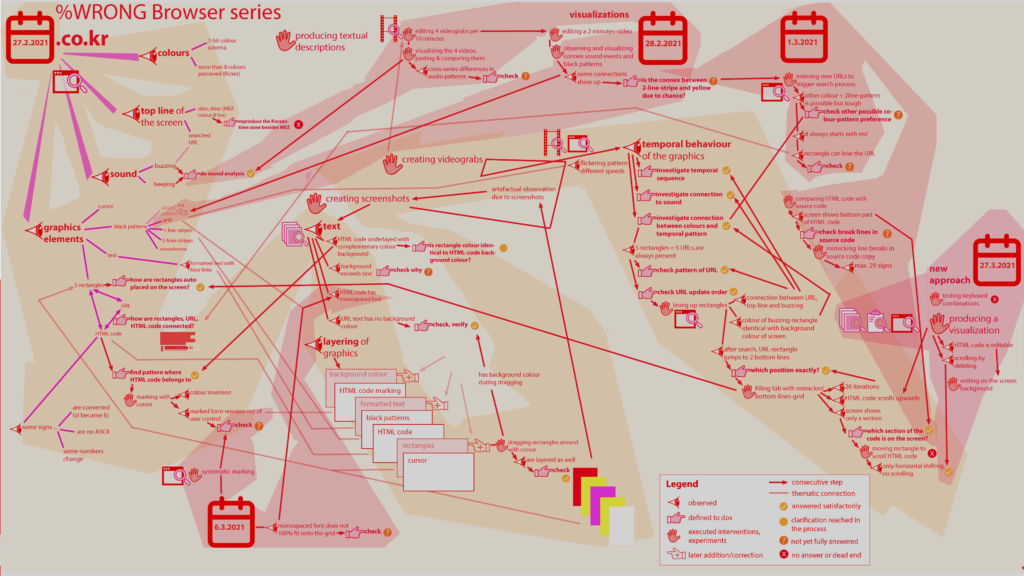
The research project investigates the genre of art browsers as procedural image machines. To this end, a phenomenological participatory approach is complemented with a computer-supported visualization method in order to create analytical views of ‘underlying’ design levels. This requires expertise from the fields of visual design, computer science, software studies and art history or image studies. The uncovering of the individual functionality of the program mechanics is pursued by testing different available visualization and analysis tools, as well as by developing visualizations especially tailored to Internet browsers. In a transdisciplinary team from art history, computer science and visual design, methodological tools for the analysis of artistic browsers will be explored. To this end established art historical methodology is complemented with approaches, which aim at visualizing the running code of the browsers.

Steve Poleskie. Between Screen Print and Sky Art
Until now, Sky Art has been understood in analogy to the simultaneously emerging Earth Art or Land Art, but scholars normally did not analyse it as a variation of the “Art & Technology” movement. This is astonishing, because as a rule it cannot be realized without ‘high tech’. The gap is closed with the most advanced representative of this genre, the US artist Steve Poleskie – who turned the sky into an ephemeral drawing board with flight performances in the 1970s and 1980s. His multifaceted work, with which he partly distinguished himself as a pioneer, is here for the first time brought into a coherent form in a monograph.
His multifaceted oeuvre has not yet been published, which is why this project is the first artist’s monograph that sheds light on Poleskie throughout his entire creative period: Beginning with abstract painting in the style of Abstract Expressionism and later on figurative painting, Poleskie soon switched to abstract landscape prints that emphasize their flatness and colour fields. He experimented with various printing techniques, then moved on to aerial theater and sky performances with stunt planes. Using this new wealth of experience and views from above he produced graphic design and collages from a dynamic aerial perspective. Later he devotes himself to still life photography, to writing novels and fantastic-surreal short stories that reflect the New York art scene of the 1960s as well as his experiences as a pilot. In addition, he played a crucial role in the emerging Pop Art scene because he founded and operated the first screen-printing workshop (Chiron Press) for artists’ supplies in New York City.

Deep Images
If one reads through media-theoretical, technology-centred and phenomenological approaches around digital images, one is struck by how precarious their status is, especially in such writings where ontological peculiarities of digital imagery are at the centre. While some thinkers in the early 2000s are still busy writing about them with a lot of scepticism, others have already started to sketch the peculiarities (interactivity, playability, the role of the spectator actors) in the 1980s. Material images are generally assumed to be on surfaces. The computer-based complexes, however, with their different levels of hardware and software, offer an entire ecosystem in which images appear in different “places” and are themselves addressable in many different levels. The project pursues an appropriate topology (for example, questions the 2-level model ‘under- and surface’ and discusses the concept of the “networked image” etc.).

Fluid formal concepts: Approaches to an aesthetics of the ephemeral
Since the 1960s, artists have been programming processes, with many of them looking for alternatives to the screen medium for their outputs. As a replacement for ‘pixels’, movable elements were used: particles, liquids, gases, which can embody the analog, digital or hybrid programmed movement. The project is dedicated to various topics in which fluids were set in motion via a meta-level (programming in a wider sense). These include investigations in wind and water tunnels from the middle of the 19th century onwards; projects for outdoor air conditioning on an urban or global scale; applications with magnetisable dust or containers with chemical gardens. All in all, this variety of nonrepresentational kinetic art leads into areas such as chemistry, physics, ecology, architecture, Cold War politics, New Materialism, and much more.

Images and Models
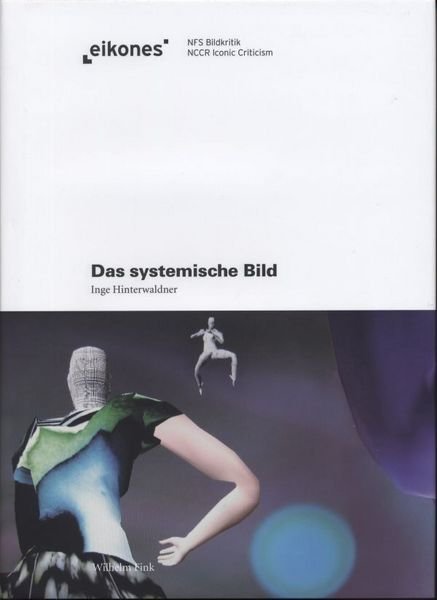
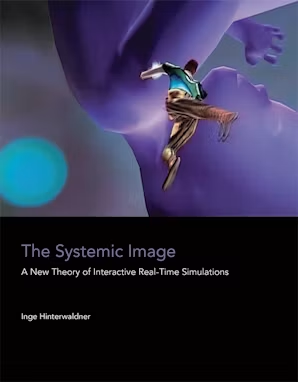
In terms of their concrete meanings and functions, both images and models are in the field of tension between representation (depicting something) and productivity (enabling something). The interdisciplinary research group “Image and Model” (2009-2013, in NCCR eikones | Image Criticism), which Inge Hinterwaldner founded and led together with sociologist Martina Merz and computer scientist Thomas Vetter at the University of Basel, was dedicated to determining these relationships from different perspectives. In her dissertation “The Systemic Image”, Inge Hinterwaldner dealt with the model theme and in this context examined iconic artefacts developed in computer-aided architecture for their operativity. Firstly, the aim is to record the manifold practices and intermediate artifacts (from CAD drawings to parameterized sketches to animations and stereolithographs) in current design processes, which are increasingly characterized by the use of computers. Secondly, the question is raised at which points in the manufacturing process and how these visual aids are used in interaction with the actions linked to them. The interest in knowledge thus aims at the iconic things made specifically for this purpose, which, due to their specific constitution and embedding of actions, prove to be agents, for example by controlling processes, provoking or inhibiting actions, directing attention, opening up changes of perception. Thirdly, a look at the design process – in which thousands of preliminary works and studies are produced even in modest pavilions – reveals a ‘big data’ problem in the context of a ‘small data’ theme, to use the jargon of the ‘digital humanities’.
Several workshops were held, as well as a symposium in 2013, which resulted in the book “Bildlichkeit im Zeitalter der Modellierung” (2017).